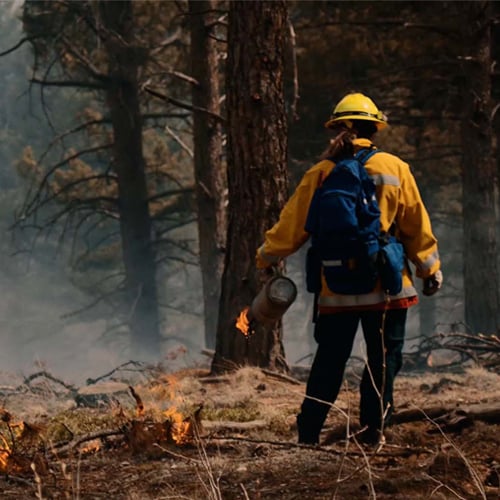


We depend on reservoirs and overhead electric lines to deliver water and power to our community. Some of these resources are located in remote mountainous areas that could be threatened by wildfire, risking damage to electrical equipment and water sources.
Wildfire mitigation
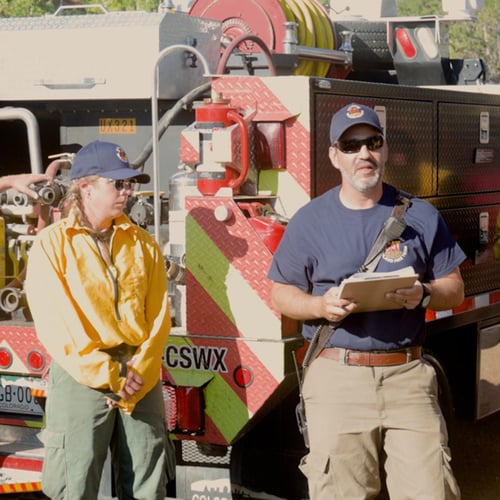
Our new Wildfire Mitigation Plan builds on decades of proactive planning and prevention, such as our in-house Wildland Fire Team and established vegetation management program.
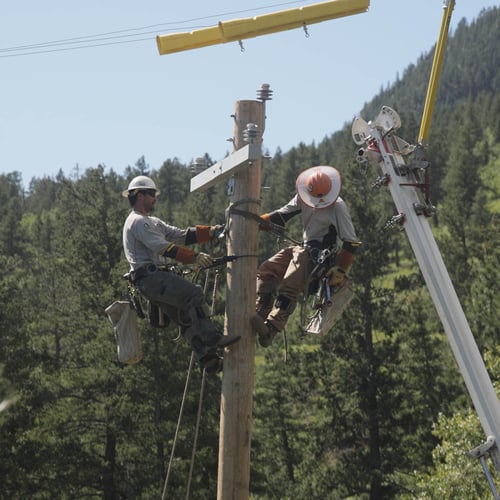
The plan focuses on three primary areas – risk assessment, risk mitigation and situational awareness – to help protect life and property, preserve electric system reliability, protect water sources and watersheds and keep our forests healthy.
Three focus areas
Risk assessment
With hundreds of miles of overhead electric lines surrounded by difficult terrain and forested areas, proactive risk identification is critical to preventing electric system-related wildfires.
Action steps:
- Testing in-house drones to get a 360-degree view of at-risk lines for vegetation risk and/or damage.
- Identifying at-risk electric equipment based on proximity to vegetation, wildlife, wildland urban interface areas and historical data such as weather patterns, vehicle damage, ignitions and wildlife interference.
- Investigating wildfire modeling software to assist with mitigation planning and our project prioritization process.
Risk mitigation
Technologies such as remote-control switches and covered conductors can help us quickly isolate an at-risk electric line or prevent damage from windblown vegetation.
Action steps:
- $3.2 million budgeted in 2025 to support our vegetation management program.
- $612,000 budgeted in 2025 to pilot system hardening projects such as covered conductors and remote-control switches to protect at-risk electric lines during extreme weather conditions.
- $3.5 million budgeted annually from 2026 – 2029 for system improvement projects.
- $2 million budgeted annually on forest restoration and wildfire mitigation projects near watersheds.
Situational awareness
Wildfires are a fact of life in Colorado. Situational awareness provides us with tools to monitor and evaluate ever-changing conditions that contribute to fire risk such as gusty winds, humidity, tree density and tree health.
No matter our situational awareness, it is impossible to eliminate wildfire risk. That’s why we embrace partnerships with local and regional first responders, and have invested in an in-house Wildland Fire Team and a water distribution system that are equipped to provide critical support early in a wildfire event.
A note about public safety power shutoffs
We do not implement Public Safety Power Shutoffs, which involve widespread, preemptive power outages. Instead, we use strategic, situational de-energization only as an absolute last resort to address an immediate threat, always prioritizing the continuity of service for our customers.
A note about undergrounding overhead lines
While limited undergrounding projects may make sense for high-risk overhead lines, the cost is four to five times the cost of overhead systems.
Costs to underground can be even higher if the terrain is rocky and hard-to-access, and the logistics for retrofitting an overhead system in these areas can be almost impossible.
Colorado Springs Utilities
It's how we're all connected.